The choice you make every turn
Every turn in Gin Rummy starts the same way: you draw one card, either the top card of the stock or the top card of the discard pile. Then you may knock or go gin if your hand qualifies, and otherwise you discard one card so you finish the turn with 10 cards.
The two piles are very different. The stock card is unknown to both players, so it can be anything you need or nothing at all. The discard is a sure thing, but your opponent sees exactly which card you took. Good players weigh both sides: what the card does for their hand, and what it tells the other player.
In most rules you may not take the top discard and throw it straight back on the same turn, so only pick it up if you plan to keep it.
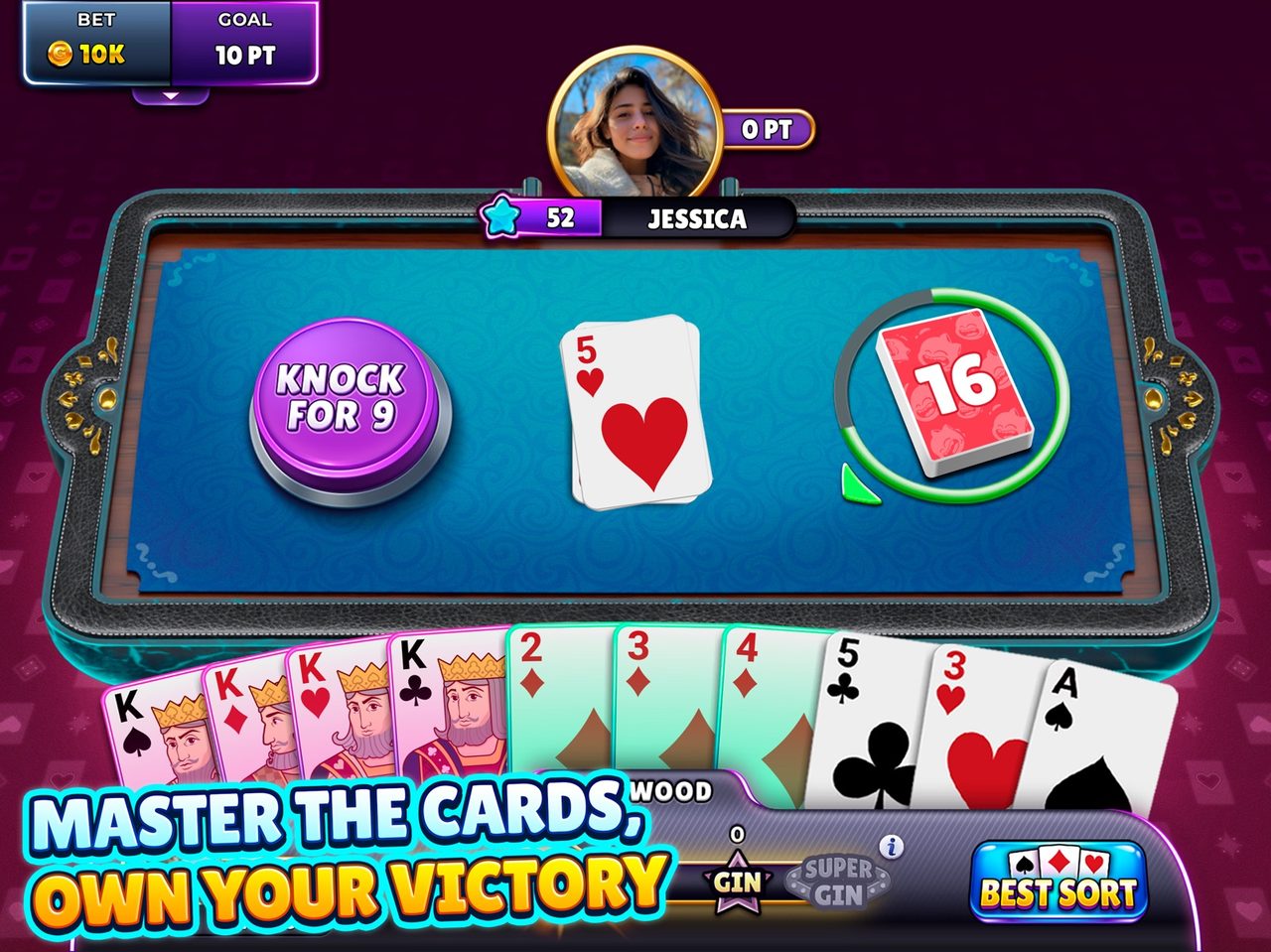
The opening upcard
After the deal, the top card of the stock is turned face up to start the discard pile. In traditional play the non-dealer may take that first card. If they decline, the dealer may take it. If both decline, the non-dealer starts by drawing from the stock. Many apps simplify this opening, so check how your table handles it.
The opening upcard follows the same logic as any other discard. Take it when it fits your hand right away, for example a third card for a pair or the missing middle of a run. A low card such as an ace or a 2 can also be worth taking for a hand that is already close to the knock limit, because it replaces a high card in your deadwood.
When taking the discard is right
The strongest reason to pick up a discard is that it improves your hand for certain. A blind draw from the stock might do the same, but it might not.
- It completes a meld. Turning a pair into a set or two connected cards into a run is the classic reason to take a discard.
- It lets you knock now or very soon. If the card brings your deadwood to 10 or less after you discard, a sure pickup beats a gamble on the stock.
- It cuts a lot of deadwood. Completing a meld with mid-value cards and then discarding a king or queen can drop your count by 20 points or more in one turn.
- It finishes gin. If the discard makes all 10 of your remaining cards fit into melds after your discard, take it and go gin.
- It extends a meld in a useful way. Adding a fourth card to a run, such as the 8 to 5-6-7, can free up another card or protect against layoffs, but only when it actually lowers your deadwood.
When to draw from the stock instead
Taking a discard that does not complete anything is usually a mistake. You give away information and you still have to throw a card back, so your hand rarely improves.
- The card only might help later. A lone card that could one day join a run is not worth showing your plans for.
- The card is high and unmatched. Picking up a stray jack or king adds 10 points of risk to your deadwood if your opponent knocks.
- You would have to break a better combination. If keeping the discard forces you to throw away part of a pair or a two-way draw, the stock is often better.
- You want to keep your hand hidden. Early in a hand, an unknown draw keeps your opponent guessing about which suits and ranks you are collecting.
Before you take a discard, ask one question: will my deadwood be lower after I throw a card back? If not, draw from the stock.
What a pickup tells your opponent
Every card taken from the discard pile is public. If you take the 8 of hearts, your opponent can work out that you probably hold two other 8s, or hearts that connect with it such as 6-7, 7-9 or 9-10. From then on they will avoid throwing you more 8s and nearby hearts.
The same works in your favour. When your opponent picks up a discard, note the card and the cards around it. Avoid discarding cards of the same rank or cards next to it in the same suit, and keep in mind that their meld may now accept your layoffs if they knock. Stock draws tell you nothing, so a player who never takes discards is harder to read but may be giving up good cards.
Worked example
You hold a set of 3s (hearts, clubs and spades), a run of 9-10-J of diamonds, and four unmatched cards: the 6 and 7 of hearts, the king of clubs and the 2 of spades. Your deadwood is 6 + 7 + 10 + 2 = 25. Your opponent discards the 8 of hearts.
If you take it, 6-7-8 of hearts becomes a run, and you can discard the king of clubs. Your only deadwood is the 2 of spades, so you can knock with 2 points right away. If you draw from the stock instead, you need a lucky card just to get close to the knock limit. Here the discard is clearly right, even though your opponent will see that you collected hearts.
| Option | Deadwood after your discard | Can you knock? |
|---|---|---|
| Take the 8 of hearts, discard the king | 2 (the 2 of spades) | Yes |
| Draw an unhelpful card from the stock, discard the king | 15 (6, 7 and 2) | No |
Late in the hand
As the stock gets smaller, the value of a sure card rises. You have fewer draws left, and your opponent is more likely to be close to knocking. In many rules, if the stock runs down to its last two cards and the player who drew before that discards without knocking, the hand is a draw and nobody scores. Taking a discard that lets you knock before that point turns a likely draw into points.
Late pickups also carry more meaning. If your opponent suddenly takes a discard after many stock draws, they may have just completed a meld and be ready to knock. Lower your own deadwood quickly by throwing your highest unmatched card, so a knock against you costs less and you have a chance to undercut.
Quick checklist
Run through these questions at the start of each turn before you touch the stock.
- Does the discard complete a set or a run?
- Will my deadwood be lower after I throw a card back?
- Does it let me knock or go gin this turn?
- Am I happy for my opponent to know I am collecting this rank or suit?
- Is the stock getting short, so a sure card matters more?
If you answer yes to the first three questions, take the card. If you answer no to all of them, draw from the stock.