What does hand mean in Gin Rummy?
The word hand has two meanings in Gin Rummy. First, your hand is the set of 10 cards you hold. After you draw you briefly hold 11, and after you discard you are back to 10. Second, a hand is one deal of the game: it starts with the shuffle and ends when someone knocks or goes gin, and its points are added to the match score.
Deadwood is every card in your hand that is not part of a meld. A meld is a set (three or four cards of the same rank) or a run (three or more cards in a row of the same suit). Face cards count 10, aces count 1 and every other card counts its number.
Which hands can end a hand of Gin Rummy?
Only a few kinds of hand let you end the deal. The table shows what each one needs and how it scores with standard values.
| Hand | What it needs | How it scores |
|---|---|---|
| Gin | All 10 cards in melds after your discard (0 deadwood) | Opponent's deadwood plus a 25-point bonus; no layoffs allowed |
| Super Gin | All 11 cards in melds right after you draw, no discard | Opponent's deadwood plus a 31-point bonus |
| Knock | 10 or fewer deadwood points after your discard | The difference between the two deadwood totals |
| Undercut (defender) | Defender's deadwood equal to or lower than the knocker's after layoffs | The difference plus a 25-point bonus, scored by the defender |
A knock is never safe just because you are allowed to knock. The lower your deadwood, the smaller the undercut risk.
What does a gin hand look like?
Gin hand example: 4-5-6-7 of hearts, 9-9-9 (spades, diamonds, clubs) and J-Q-K of clubs. That is 4 + 3 + 3 = 10 cards, all in melds, so the deadwood is 0. You discard your eleventh card and lay down a gin hand.
Super Gin hand example, right after drawing: A-2-3-4 of spades, 7-7-7 (hearts, diamonds, clubs) and 10-J-Q-K of hearts. That is 4 + 3 + 4 = 11 cards, all melded, so you lay down the whole hand without a discard. Not every table plays Super Gin, but on this site it is worth a 31-point bonus.
What does a knocking hand look like?
Knocking hand example: 7-8-9 of spades, Q-Q-Q (hearts, diamonds, clubs), A-2-3 of diamonds and the 5 of clubs. Nine cards are melded and the 5 of clubs is the only deadwood, so you have 5 points and can knock.
Weak hand example: 2-3-4 of clubs, the 10 of hearts, 10 of spades, king of diamonds, 8 of hearts, 6 of spades, jack of clubs and 5 of diamonds. Only one run is complete. The deadwood is 10 + 10 + 10 + 8 + 6 + 10 + 5 = 59, far above the knock limit, so this hand needs several more draws.
| Example | Melds | Deadwood | Can it knock? |
|---|---|---|---|
| Gin hand | 4-5-6-7 hearts, three 9s, J-Q-K clubs | 0 | Yes - gin |
| Knocking hand | 7-8-9 spades, three queens, A-2-3 diamonds | 5 | Yes |
| Weak hand | 2-3-4 clubs only | 59 | No |
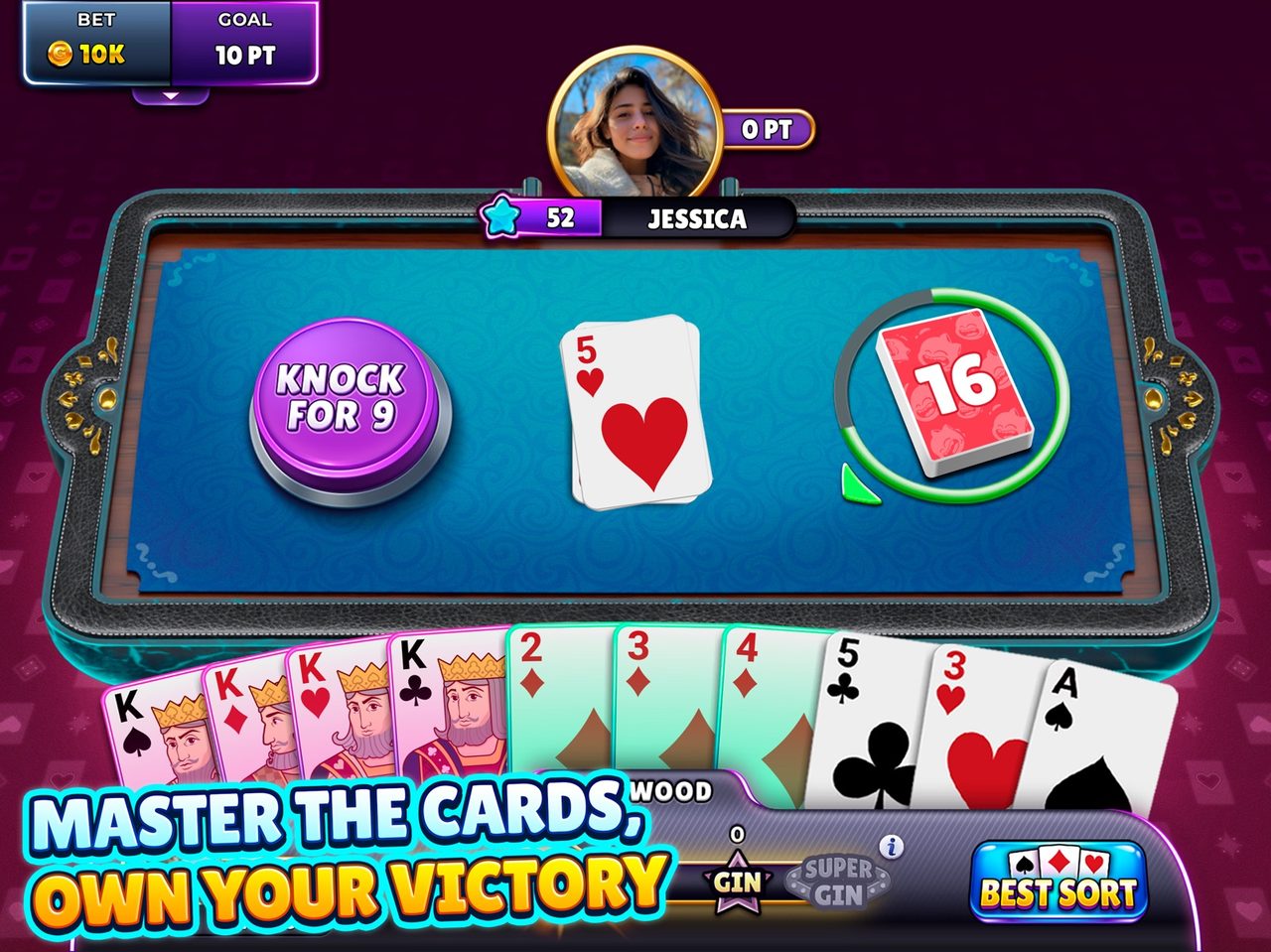
How do you arrange a hand when a card fits two melds?
Each card can belong to only one meld, so a card that fits both a set and a run forces a choice. Count the deadwood both ways and keep the lower total.
Example: you hold 6-7-8 of clubs plus the 8 of hearts and 8 of diamonds. If the 8 of clubs stays in the run, the two red 8s are deadwood: 8 + 8 = 16. If the 8 of clubs joins the red 8s as a set, the 6 and 7 of clubs are deadwood: 6 + 7 = 13. The set arrangement saves 3 points.
Most online games, including Gin Rummy Super, sort and count your melds for you, but knowing the logic helps you choose which card to throw.
How do you judge a starting hand?
A starting hand is rarely close to a knock. What matters is how many ways it can improve. Look for these features:
- Complete melds: any set or run you are dealt is a head start.
- Pairs: two cards of the same rank need one of two remaining cards to become a set.
- Connectors: two cards in a row of the same suit, such as 3-4 of hearts, can become a run from either end (unless an ace or king blocks one side).
- Low cards: aces, 2s and 3s cost little if they stay unmatched.
- High loners: unmatched jacks, queens and kings are the first cards to throw.
Example: a starting hand with a pair of 8s, 3-4 of hearts and an ace and a 2 is worth keeping together; throw the stray face cards first.
How do you turn a weak hand into a knocking hand?
Lower your deadwood one discard at a time. Throw your highest unmatched card when nothing else is clearly better, keep pairs and connectors that still have live cards, and take the top discard only when it completes a meld or cuts your deadwood after you throw a card back.
Watch the discard pile as you go. If two of the cards you need for a set are already discarded, that pair is dead and its cards become candidates to throw.
Where can you practise reading Gin Rummy hands?
The free Daily Deal puzzle on this site gives everyone the same 10 cards each day. You arrange them into melds, the site checks your answer and shows the best possible deadwood, which is good practice for spotting sets, runs and overlapping cards quickly.
Then put it to work in live matches against real players in Gin Rummy Super, in your browser or on iOS and Android.